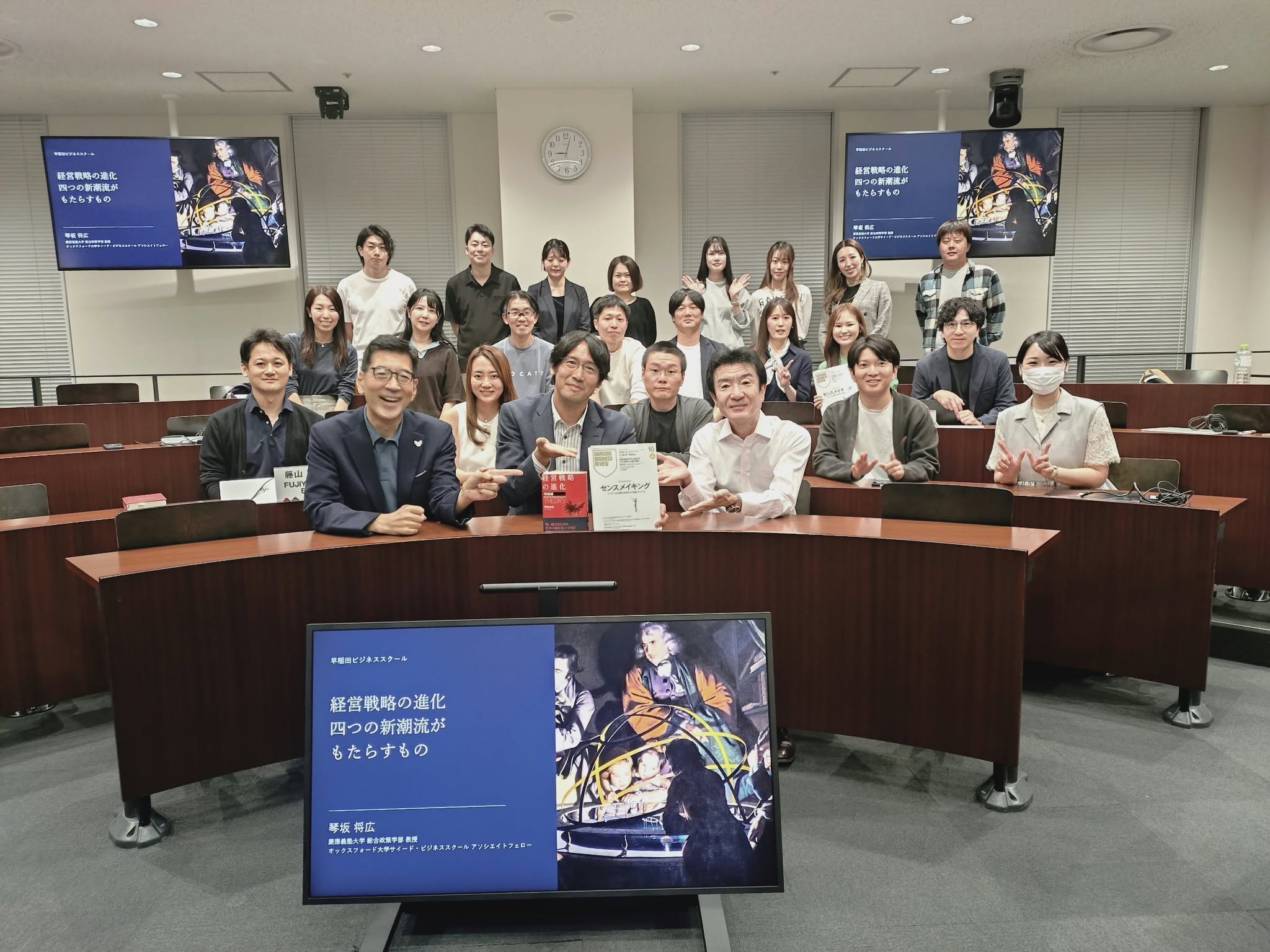
2026年10月9日(金)、早稲田大学ビジネススクール(WBS)の 池上重輔教授、入山章栄教授、澁谷覚教授 のゼミによる合同企画として、琴坂将広が「経営戦略の進化──四つの新潮流がもたらすもの」と題して講演し、教授陣や受講生と議論しました。題材は、『DIAMOND ハーバード・ビジネス・レビュー』2026年10月号の特集2に掲載された共著論文「経営戦略50年の進化を10の視座から読み解く」(琴坂将広・ジョナサン・トレバー)と、『経営戦略の進化〈理論編〉』(東洋経済新報社)です。会場は早稲田キャンパスの11号館で、セッションは19時に始まりました。
On Friday 9 October 2026, Masahiro Kotosaka gave a lecture titled "The Evolution of Strategy: Four New Currents and What They Bring" at a joint session organised by the seminars of Professors Jusuke Ikegami, Akie Iriyama and Satoru Shibuya at Waseda Business School (WBS), followed by discussion with the faculty and students. The lecture drew on two sources: his article with Jonathan Trevor in the October 2026 issue of DIAMOND Harvard Business Review, "The Evolution of Strategy: Ten Perspectives on Fifty Years of Strategic Management Thinking", and his book The Evolution of Strategic Management (Theory) (Toyo Keizai). The session began at 7 p.m. in Building 11 on the Waseda Campus.
Structure of the lecture 講演の構成
講演は三部で構成しました。第1部では、経営戦略論の半世紀を10の視座で振り返り、競争優位の捉え方がどう変わってきたかを確かめました。第2部では、四つの新潮流のうち、実践・行動、多層的境界、非市場・制度の三つを取り上げ、社内・社外・社会のそれぞれで競争優位を高める方法を、事例をもとに検討しました。第3部では、残る一つの新潮流、アルゴリズムとロボティクスが、顧客行動、組織の形、戦略の在り方をどう変えうるかを論じました。第2部と第3部の事例の多くは、2027年1月頃に刊行予定の『経営戦略の進化〈実践編〉』で扱う内容です。
The lecture had three parts. Part 1 reviewed fifty years of strategy research through the ten perspectives and traced how the understanding of competitive advantage has changed. Part 2 took up three of the four new currents (practice and behaviour, multi-layered boundaries, and non-market and institutional strategy) and used cases to examine how a firm can strengthen its advantage inside the firm, beyond its boundaries and in society. Part 3 considered how the fourth current, algorithms and robotics, may change customer behaviour, the shape of organisations and the nature of strategy. Many of the cases in Parts 2 and 3 will be covered in the forthcoming practice volume, The Evolution of Strategic Management (Practice), due from Toyo Keizai around January 2027.
Part 1: What is competitive advantage? 第1部 競争優位とは何か
出発点は、持続的な競争優位を「一時的優位の連続的創造」として捉える見方です。今の強みを使って成果を出しながら次の強みをつくり、そのあいだで投資と撤退を判断します。40産業の25年間のデータを調べた研究でも、高い業績を長く続けた企業はごく限られていました(Wiggins & Ruefli, 2002)。今うまくいっているからといって、その延長だけで次の計画を立てないことが大切です。
The starting point was to see sustained competitive advantage as the continuous creation of temporary advantages: using today's strengths to deliver results while building the next ones and, between the two, deciding where to invest and where to withdraw. In a study of 40 industries over 25 years, Wiggins and Ruefli (2002) found that very few firms sustained superior performance for long. The lesson is not to build the next plan merely by extending what works today.
10の視座のうち、視座1〜6(SWOT、アンゾフ・マトリックス、BCGマトリックス、ファイブ・フォース、リソース・ベースト・ビュー、知識と能力の動態)は、現在の経営戦略の基礎をなしています。古いから使わなくてよいのではなく、それぞれが何を考えるための道具だったのかを理解して使うことが大切です。分析は今も土台ですが、研究の関心は、その分析を使って人が何を選び、実際にどう行動に移すかへと及ぶようになりました。視座7〜9は、この判断と行動を社内・社外・社会の三つの広がりで捉え直すものです。そこに視座10のアルゴリズムとロボティクスが、前提の変化として加わります。
Of the ten perspectives, Perspectives 1–6 (SWOT, the Ansoff matrix, the BCG matrix, the five forces, the resource-based view and the dynamics of knowledge and capabilities) remain the foundation of strategy today. They are not obsolete; what matters is to understand what question each was built to address, and to use it accordingly. Analysis remains the groundwork, but research has come to ask how people use it to make choices and turn them into action. Perspectives 7–9 re-examine those decisions and actions inside the firm, beyond its boundaries and in society; Perspective 10, algorithms and robotics, changes the assumptions beneath all three.
Part 2: Strengthening advantage through three new currents 第2部 三つの新潮流で競争優位を高める
社内については、視座7「実践・行動としての経営戦略」を取り上げました。柱は二つです。判断の癖のうち、助けになるものと弱点になるものを見分け、組織の仕組みで手当てするバイアス・コントロールと、資料の様式や会議の進め方、空間の動線を設計するプラクティス・デザインです。例として、会議の冒頭に6ページのメモを全員で黙読するアマゾンの運用、前提と反証を一枚に残すトヨタのA3、部門の異なる人がすれ違うように動線を設計したピクサーの本社を挙げました。一方で、オープンオフィスがかえって対面の交流を減らしたという研究(Bernstein & Turban, 2018)も紹介し、壁を取り払うだけでは人は交わらないことにも触れました。
Inside the firm, the lecture took up Perspective 7, strategy as practice and behaviour, through two ideas. Bias control distinguishes the habits of judgement that help from those that harm, and handles them through organisational routines; practice design shapes document formats, meeting procedures and the movement of people through space. The examples were Amazon's practice of having everyone read a six-page memo in silence at the start of a meeting, Toyota's A3 reports that keep assumptions and counter-evidence on a single sheet, and Pixar's headquarters, laid out so that people from different departments cross paths. The lecture also cited research showing that moving to open-plan offices actually reduced face-to-face interaction (Bernstein & Turban, 2018): removing walls does not by itself bring people together.
社外については、視座8「多層的境界の戦略」を取り上げました。自社の範囲を所有・統治・協業の三層で捉え直すと、優位の源泉が社内だけでなく、他者との接点にもあることが見えてきます。住宅用太陽光の産業を10年にわたって追った研究(Hannah & Eisenhardt, 2018)では、価値の流れを詰まらせる要因が、施工の能力から購入資金の調達へ、さらに顧客の獲得へと移りました。エコシステムの優位はこうした詰まり(関係性のボトルネック)の周りに生まれ、その位置は動きます。戦略家には、関係の構造を意図して設計する建築家の顔と、自然に生まれた芽を見つけて育てる庭師の顔があります。すぐれた戦略家は、場面ごとにこの二つの顔を使い分けます。
Beyond the firm, the subject was Perspective 8, strategy across multi-layered boundaries. Seeing the firm in three layers (ownership, governance and collaboration) shows that advantage can come from connections with others, not only from what the firm owns. In a ten-year study of the residential solar industry (Hannah & Eisenhardt, 2018), the bottleneck shifted from installation capacity to purchase financing and then to customer acquisition. Advantage in an ecosystem forms around such relational bottlenecks, and their position moves. A strategist plays two roles: the architect, who deliberately designs the structure of relationships, and the gardener, who spots and tends what emerges on its own. The best strategists move between the two as the situation demands.
社会については、視座9「非市場・制度の戦略」を取り上げました。制度には、法令だけでなく、業界や社会の規範、人々が当たり前と考える前提も含まれます(スコットの制度の三本柱)。ルールに働きかける道として、テスラが州ごとに直販の解禁を積み重ねた漸進の道と、ウーバーやエアビーアンドビーが既成事実を先行させた急進の道を対比しました。急進に味方するのは速度とネットワーク効果ですが、事業を持続させるのは正統性です。
In society, the subject was Perspective 9, non-market and institutional strategy. Institutions include not only laws but also the norms of an industry or a society and the assumptions people take for granted (Scott's three pillars). The lecture contrasted two ways of changing the rules: the incremental route, in which Tesla won the right to sell directly state by state, and the radical route, in which Uber and Airbnb established a fait accompli before regulators could respond. Speed and network effects favour the radical route, but what sustains a business is legitimacy.
Part 3: Algorithms and robotics 第3部 アルゴリズムとロボティクス
経営戦略は長く、人が考え、人が実行することを前提にしてきました。第3部では、この前提が変わったときに何が起きるかを、顧客行動、組織の形、戦略の在り方の三つの軸で整理しました。研究の動きが速い領域のため、確定した理論ではなく、いま見えている輪郭として聞いてほしいと断ったうえでの議論です。顧客については、ある時点の調査から平均的な顧客像をつくるだけでなく、一人ひとりの「いま」を知り続けることが重要になる、という見方を示しました。組織については、少人数で大きな収益を上げる企業が現れていることや、キリンホールディングスのAI役員、ショッピファイの採用方針といった例を挙げ、経営層の仕事が個別の判断から、判断の仕組みを設計し統治することへ移りつつあると論じました。
Strategy has long assumed that people do the thinking and people carry out the work. Part 3 asked what happens when that assumption changes, along three lines: customer behaviour, the shape of organisations and the nature of strategy. Because research in this area is moving quickly, Kotosaka asked the audience to treat this part as an outline of what can be seen now rather than settled theory. On customers, he argued that firms will increasingly need to track each person's present situation rather than rely only on an average profile from a one-off survey. On organisations, he pointed to firms that generate large revenues with very few employees, and to examples such as the "AI executive" Kirin Holdings has added to its strategy meetings and Shopify's hiring policy, arguing that the work of senior management is shifting from making individual decisions to designing and governing how decisions are made.
戦略の在り方については、生成AIが個人の創造性を高める一方で、集団としての発想を似通わせるという研究(Doshi & Hauser, 2024)を紹介し、汎用のAIを入れるだけでは優位は生まれにくいと論じました。そのうえでケンプの「状況適応型AI」を引き、同じ基盤モデルは競合も使えるのだから、差になるのは自社のデータや業務にどこまで深く組み込めるかだと述べました。あわせて、AIに任せる範囲を広げるには、何をさせないかを決めるガードレール、どう動かしどう測るかを定めるハーネス、後から検証できる監査が要ることを指摘しました。最後に、企業は規模で個別対応を量産する型と、選好の一貫性で勝つ小さな作り手とに分かれ、その中間は消えていく、という見通しを示しました。企業の分岐そのものは観測されていますが、二極化は琴坂自身の予測だと断っています。
On the nature of strategy, he introduced research showing that generative AI raises individual creativity while making a group's ideas more alike (Doshi & Hauser, 2024), and argued that simply adopting general-purpose AI is unlikely to create an advantage. Drawing on Kemp's idea of "situated AI", he noted that competitors can use the same foundation models, so the difference lies in how deeply a firm builds them into its own data and work. He also pointed out that extending what AI is trusted to do requires guardrails that set what it must not do, a harness that defines how it runs and how it is measured, and audits that allow decisions to be checked afterwards. Finally, he set out a forecast: firms will split into those that use scale to mass-produce individual customisation and small makers that win through consistent taste, and the middle ground will disappear. He made clear that while the divergence between firms has been observed, the polarisation is his own prediction.
What the four currents bring 四つの新潮流がもたらすもの
結びでは、第1部で示した時間軸に立ち返り、四つの新潮流がもたらすものを、明日からその先までの四つの仕事にまとめました。
To close, the lecture returned to the timeline shown in Part 1 and summed up what the four currents bring as four tasks, from tomorrow to the longer term.
- 明日:会議の運び方を変える(視座7)
From tomorrow: change how meetings are run (Perspective 7) - 半年:境界を引き直す(視座8)
Over six months: redraw the firm's boundaries (Perspective 8) - 数年:ルールを設計する(視座9)
Over several years: design the rules (Perspective 9) - その先:自律的な循環を統治する(視座10)
Beyond: govern autonomous loops (Perspective 10)
四つの仕事に使う道具は、いずれも今では多くの企業が使える共有財です。差を生むのは、それを自社の価値観と文脈にどう埋め込むかです。
The tools for all four tasks are now common property, available to many firms. What makes the difference is how each firm embeds them in its own values and context.
Discussion 議論
講演の後は、教授陣や受講生との議論に移り、講演の内容を企業の実務にどう生かすかを中心に意見を交わしました。
The lecture was followed by discussion with the faculty and students, centred on how the ideas in the lecture can be put to work in companies.
本セッションを企画してくださった池上重輔教授、入山章栄教授、澁谷覚教授、そして議論に加わってくださったゼミの皆さんに感謝いたします。
We thank Professors Jusuke Ikegami, Akie Iriyama and Satoru Shibuya for organising the session, and the members of their seminars for joining the discussion.
10の視座の全体像は DHBR 2026年10月号の共著論文で、経営戦略論の系譜は『経営戦略の進化〈理論編〉』で読むことができます。