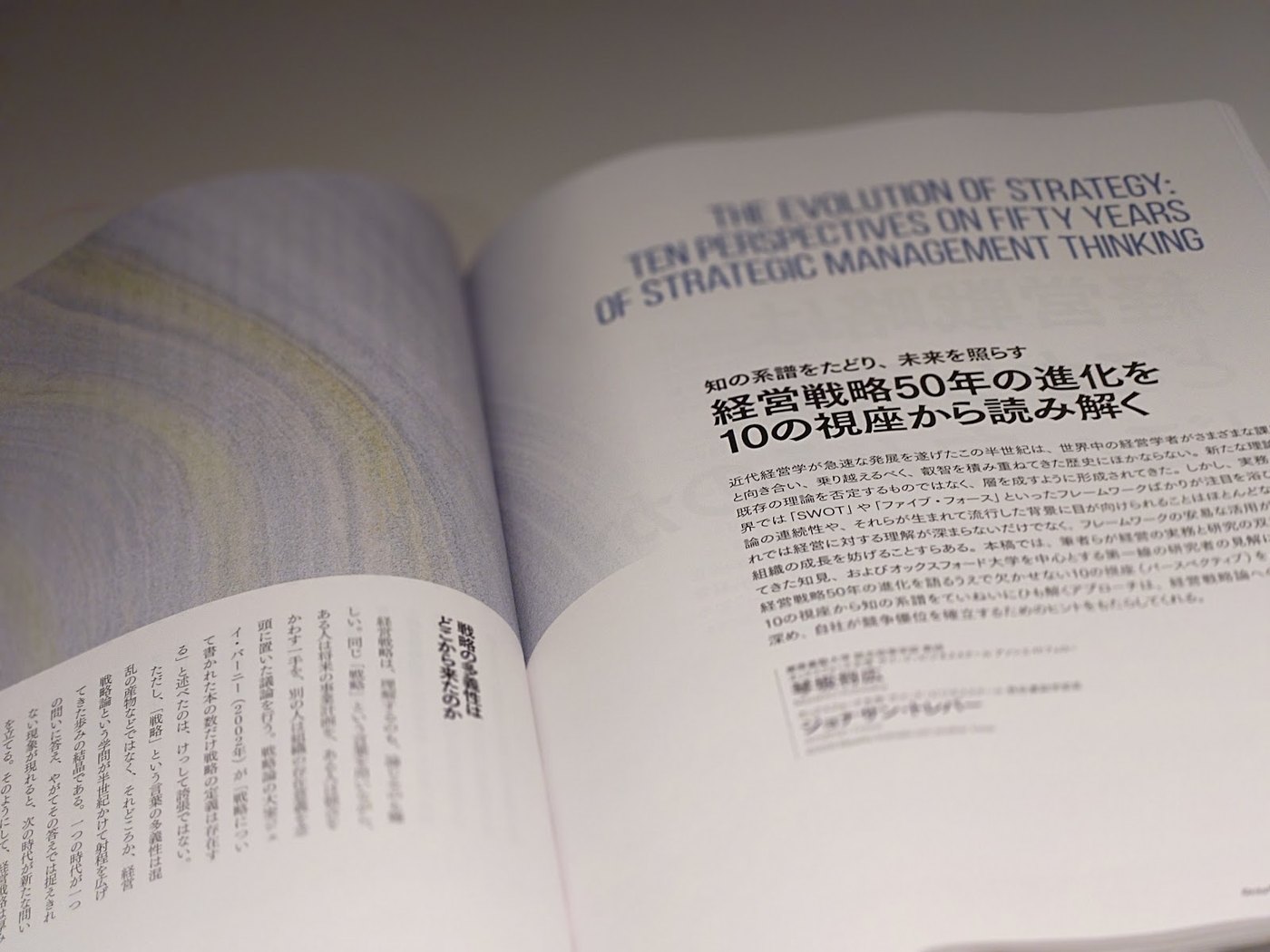
2026年9月10日発売の『DIAMOND ハーバード・ビジネス・レビュー』2026年10月号(創刊50周年記念号)に、琴坂将広と ジョナサン・トレバー(オックスフォード大学 サイード・ビジネススクール 教授兼副学部長)の共著論文 「経営戦略50年の進化を10の視座から読み解く ― 知の系譜をたどり、未来を照らす」 が掲載されました。特集2「経営戦略はどこから来て、どこへ向かうのか」を構成する論文で、誌面はpp.80–110、図表は11点です。SWOTからアルゴリズムとロボティクスまで、経営戦略論の半世紀を10の視座に整理し、それぞれの理論がどの時代に、何を説明しようとして生まれたのかをたどっています。英語版 The Evolution of Strategy: Ten Perspectives on Fifty Years of Strategic Management Thinking も DHBR オンラインで公開されています。
The October 2026 issue of DIAMOND Harvard Business Review, which marks the magazine's fiftieth anniversary, went on sale on 10 September 2026. It carries a co-authored article by Masahiro Kotosaka and Jonathan Trevor (Professor of Management Practice and Associate Dean for Practice and Affiliates, Oxford Saïd Business School), "The Evolution of Strategy: Ten Perspectives on Fifty Years of Strategic Management Thinking — Tracing the intellectual roots of strategy to illuminate its future" (pp. 80–110, with eleven exhibits). It appears as the issue's second feature, "Where has strategy come from, and where is it heading?" The article organises half a century of strategy research, from SWOT to algorithms and robotics, into ten perspectives, and asks of each when it emerged and what it was meant to explain. An English version is also published on the DHBR website.
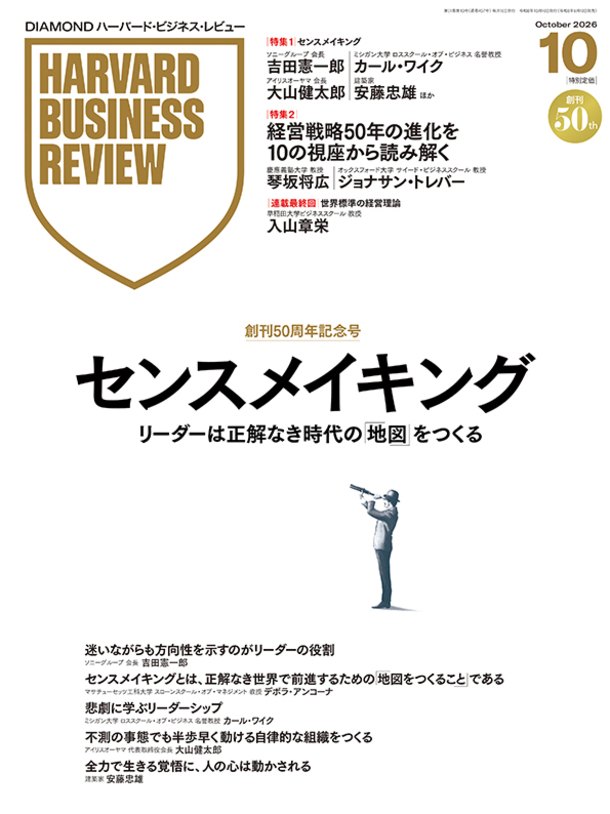
創刊50周年記念号の特集1は「センスメイキング」、特集2はこの論文です。表紙の特集2の欄には、論文の題と著者2人の名前が載っています。日本語版と英語版は、いずれも DHBR オンラインで有料会員向けに公開されています。
The anniversary issue's first feature is on sensemaking; this article forms the second, and its title and both authors' names appear on the cover. On the DHBR website, both the Japanese and the English versions are for subscribers only.
論文の問い · The question behind the article
経営戦略という言葉は、人によって指すものが違います。将来の事業計画を思い浮かべる人もいれば、競合をかわす一手や、組織の存在意義を考える人もいます。論文は、この多義性を混乱の表れではなく、経営戦略論が半世紀をかけて射程を広げてきた歩みの産物と捉えます。ある時代の答えで捉えきれない現象が現れると、次の時代が新しい問いを立てます。新しい理論は古い理論を置き換えるのではなく、層を成すように積み重なってきた、という見方です。
"Strategy" means different things to different people: a plan for the business, a move against a competitor, or an organisation's reason for being. The article treats this multiplicity not as confusion but as the result of a discipline that has widened its reach over fifty years. When phenomena appear that one era's answer cannot explain, the next era asks a new question. New theories have not replaced the old ones so much as been laid on top of them.
一方で実務の場では、SWOTやファイブ・フォースといったフレームワークだけが切り出され、それが生まれた時代背景や理論上の問題意識は置き去りにされがちです。論文は、各視座が流行した理由を時代背景と学術的背景の両面から解き明かし、それぞれのフレームワークが何を説明でき、何を説明できないのかを示すことを狙いとしています。
In practice, however, frameworks such as SWOT and the five forces are often lifted out of the circumstances that produced them. The article explains why each perspective rose to prominence, from both a historical and an academic angle, so that readers can see what each framework can and cannot explain.
10の視座 · The ten perspectives
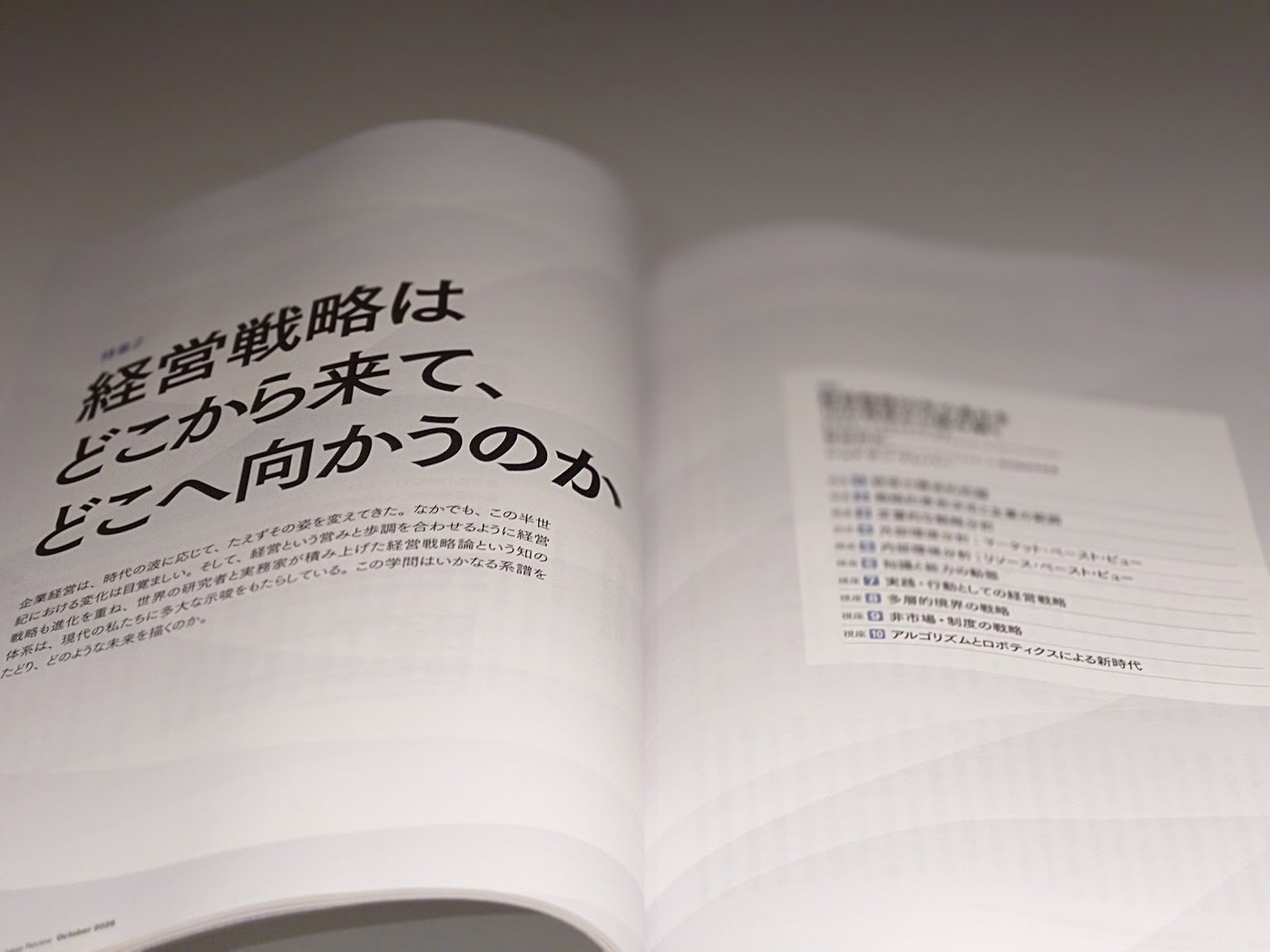
論文が選んだ10の視座は次のとおりです。視座1〜6は年代と代表的なフレームワークを伴う古典の系譜、視座7〜10は2010年代以降に並行して注目されている4つの新潮流です。
The ten perspectives are listed below. Perspectives 1–6 form a classical lineage, each tied to a period and a representative framework; Perspectives 7–10 are four new currents that have gained prominence in parallel since the 2010s.
- 経営の構造的把握(1950〜1960年代、SWOT)
A structural understanding of management (1950s–1960s; SWOT) - 戦略的意思決定と企業の範囲(1960〜1970年代、アンゾフ・マトリックス)
Strategic decision-making and the scope of the firm (1960s–1970s; the Ansoff matrix) - 定量的な戦略分析(1970年代、BCGマトリックス)
Quantitative strategic analysis (1970s; the BCG matrix) - 外部環境分析:マーケット・ベースト・ビュー(1970年代後半〜1980年代、ファイブ・フォース)
External environment analysis: the market-based view (late 1970s–1980s; the five forces) - 内部環境分析:リソース・ベースト・ビュー(1980年代後半〜1990年代、VRIO)
Internal environment analysis: the resource-based view (late 1980s–1990s; VRIO) - 知識と能力の動態(1990〜2000年代、SECIモデル)
The dynamics of knowledge and capabilities (1990s–2000s; the SECI model) - 実践・行動としての経営戦略(マイクロファンデーションと実践理論)
Strategy as practice and behaviour (microfoundations and practice theory) - 多層的境界の戦略(リレーショナル・ビュー)
Strategy across multilayered boundaries (the relational view) - 非市場・制度の戦略(インスティテューション・ベースト・ビュー)
Nonmarket and institutional strategy (the institution-based view) - アルゴリズムとロボティクスによる新時代
A new era of algorithms and robotics
外部から内部へ、そしてその先へ · From the external to the internal, and beyond
論文はまず、50年の流れを大づかみに描きます。1960〜70年代に、経営を外と内の両面から捉える型(視座1)、予算に先立って全社の方向と企業の範囲を定める考え方(視座2)、複数事業への投資の優先順位を見極める手法(視座3)がそろい、経営は分析できる対象になりました。そのうえで、「競争優位はどこから生まれるのか」という問いが前面に出てきました。最初に目が向いたのは組織の外側で、マイケル・ポーターが産業組織論のSCPパラダイムを経営戦略に翻訳しました(視座4)。続いて、同じ業界の企業のあいだになぜ業績差が生じるのかという問いから、視線は組織の内側へ移りました(視座5)。さらにその先で、資源がどう生まれ、どう更新されるのかを問うたのが視座6です。
The article begins with a broad overview of the fifty years. In the 1960s and 1970s, three things made management something that could be analysed: a way of looking at it from outside and inside (Perspective 1), the idea of setting corporate direction and the scope of the firm before the budget (Perspective 2), and methods for prioritising investment across businesses (Perspective 3). Only then did the question of where competitive advantage comes from move to the fore. Attention turned first to the outside of the firm, as Michael Porter translated the structure–conduct–performance paradigm of industrial organisation into strategy (Perspective 4). The question of why firms in the same industry perform differently then turned attention inwards (Perspective 5), which in turn raised the question of how those resources are created and renewed (Perspective 6).
外部環境と内部環境を起点とするこの2つの視座(視座4・5)は、欧米のビジネススクールで広く使われる教科書の多くで、いまも経営戦略論の二本柱として扱われています。しかし1990年代後半以降、外部と内部の二項対立だけでは捉えきれない現象が増えてきました。論文は視座7〜10を、この二項対立が積み残してきた4つの空白、すなわち「内部の奥」「外部と内部の間」「外部の背後」「人間という前提の外側」を埋める補完的な試みとして位置づけます。4つの視座は、打ち手の成果が表れるまでの時間軸の順に並んでいます。
The market-based and resource-based views, starting from the external and the internal environment respectively, remain the twin pillars of many widely used strategy textbooks. Since the late 1990s, however, a growing number of phenomena have fallen outside this external–internal divide. The article presents Perspectives 7–10 as complementary attempts to fill the four gaps it has left: deeper within the organisation, between its inside and outside, behind the external environment, and beyond the assumption of human agency. The four are ordered by the time their interventions take to produce results.
古典となった6つの視座 · The six classical perspectives
前半の6つの視座について、論文はよく知られたフレームワークの背後にある時代の要請と理論の系譜をたどります。
For each of the first six perspectives, the article traces the demands of the era and the theoretical lineage behind a familiar framework.
- 視座1 — SWOTの原型は、ハーバード・ビジネス・スクールで磨かれたビジネスポリシー講義を背景に、1965年の著書 Business Policy: Text and Cases で示されたLCAGモデルにあります。のちの調査では、SWOTを用いた20社のうち、その成果物が戦略策定に生かされたのは3社にとどまったと報告されています。論文はそれでも、捉えどころのなかった経営を、誰もが同じ土俵で論じられる対象に変えた点にSWOTの価値を見ます。
SWOT has its roots in the LCAG model, set out in Business Policy: Text and Cases (1965) against the background of the business policy course at Harvard Business School. A later study found that only three of twenty firms that used SWOT carried its output into strategy formulation. The article nonetheless sees SWOT's value in turning management, once hard to pin down, into something everyone could discuss on common ground. - 視座2 — H・イゴール・アンゾフは『企業戦略論』(1965年)で、予算や計画に先立って組織の進む方向を定めるべきだと論じました。予算ありきから、戦略ありきへの転換です。同時期のアルフレッド・チャンドラー『組織は戦略に従う』(1962年)とあわせて、戦略が経営の根幹にあることが示されました。
In Corporate Strategy (1965), H. Igor Ansoff argued that an organisation should set its direction before its budgets and plans: strategy first, budget second. Together with Alfred Chandler's Strategy and Structure (1962), his work placed strategy at the centre of management. - 視座3 — BCGマトリックスは、経験曲線とプロダクトライフサイクルという出自の異なる2つの理論を一枚の図に重ねたものです。コンサルティング会社が研究と実践を誰もが使える道具に翻訳し、フレームワークの民主化が始まったのはこの時代でした。ただし、理論を理解しないまま「金のなる木」「負け犬」といった分類だけが使われる劣化も招いた、と論文は指摘します。
The BCG matrix combined two theories of different origin, the experience curve and the product life cycle, in one diagram. The democratisation of frameworks began in this era, as consulting firms turned research and practice into standard tools; but, the article notes, it also led to misuse, as labels such as "cash cow" and "dog" were applied without the theory behind them. - 視座4 — ポーターは、数理モデルが中心で敷居の高かった産業組織論を、5つの競争要因という見通しやすい形に翻訳し、実務家から圧倒的な支持を得ました。同じ時期の日本では、大前研一の『企業参謀』(1975年)が、のちの3Cの原型を示しています。
Porter recast industrial organisation economics, then dominated by mathematical models, as five competitive forces that practitioners could readily grasp, and won their overwhelming support. In Japan at the same time, Kenichi Ohmae's Kigyō Sanbō (1975), later published in English as The Mind of the Strategist, set out the prototype of the 3Cs. - 視座5 — リチャード・ルメルト(1991年)の分析では、企業間の業績差のうち安定的な業界要因の寄与は約8%にとどまり、産業内の事業単位に固有の要因が約46%を占めました。この結果は、業績差の源泉を企業内部に求める資源ベース理論を裏づけるもので、ジェイ・バーニーのVRIOは研究と教育の共通言語になりました。
Richard Rumelt's 1991 analysis found that stable industry factors accounted for only about 8% of the variance in performance, while factors specific to business units within an industry accounted for about 46%. The findings supported the resource-based view, which locates the source of such differences inside the firm, and Jay Barney's VRIO became a common language in research and teaching. - 視座6 — 資源は、静的な保有物としてではなく、たえず生成され更新されるものとして捉え直されます。知識ベース理論、野中郁次郎のSECIモデル、ダイナミックケイパビリティ理論がその系譜です。論文は、日本の読者にその意義を伝える意図も込めて、日本発のSECIモデルを視座6の代表的なフレームワークに据えています。
Resources came to be seen not as static holdings but as something continually created and renewed, through the knowledge-based view, Ikujiro Nonaka's SECI model and dynamic capabilities theory. The article gives the Japanese-born SECI model this place partly to highlight its significance for Japanese readers.
4つの新潮流 · The four new currents
後半の4つの視座は、まだ定まった型を持たない、現在進行形の議論です。論文はここで、オックスフォード大学サイード・ビジネススクールの研究者への取材も交えています。
The last four perspectives are debates still in motion, without settled frameworks. Here the article also draws on interviews with scholars at Oxford Saïd Business School.
視座7 実践・行動としての経営戦略 · Strategy as practice and behaviour
人間の認知と感情から戦略を捉え直す「行動戦略」と、リチャード・ウィッティントンが名づけた「実践としての戦略」(SAP)という2つの系統を、分析単位の違い(個人か、共有された実践か)から整理します。戦略を完成された計画ではなく行動の産物と見るなら、問われるのは計画の正しさよりも、組織のなかで正しい行動が生まれる条件を整えられるかどうかです。ウィッティントン氏への取材では、今後の方向として、戦略策定をより多くの成員へ開く「オープン戦略」が挙げられました。
The article distinguishes two strands by their unit of analysis: behavioural strategy, which reframes strategy through human cognition and emotion and focuses on the individual, and strategy-as-practice (SAP), a term coined by Richard Whittington, which focuses on shared practice. If strategy is the product of action rather than a finished plan, the question is less whether the plan is right than whether the organisation creates the conditions in which the right actions emerge. In an interview with the authors, Whittington pointed to open strategy, which extends strategy-making to more members of the organisation, as an important direction for the field.
視座8 多層的境界の戦略 · Strategy across multilayered boundaries
分析単位を企業から企業間の関係そのものへ移すリレーショナル・ビューを起点に、エコシステム、プラットフォーム、コミュニティの3つの軸を、入れ子になった構造として整理します。どの形を中心に据えるかの手がかりは、価値の流れを最も詰まらせる「痛点」(ボトルネック)の所在にあります。ピナール・オズジャン氏は取材で、競争の焦点が商品そのものから顧客との接点やデータ、そしてエコシステム全体を束ねる「オーケストレーター」へ移っていくと語っています。
Starting from the relational view, which moves the unit of analysis from the firm to the relationships between firms, the article treats ecosystems, platforms and communities as nested layers. The starting point for deciding which form to put at the centre is the bottleneck that most restricts the flow of value. In an interview with the authors, Pinar Ozcan described competition shifting from products towards customer interfaces, data and the "orchestrators" that coordinate entire ecosystems.
視座9 非市場・制度の戦略 · Nonmarket and institutional strategy
規制当局や社会に働きかける比較的短い時間軸の非市場戦略と、規範や常識そのものを書き換える長い時間軸の制度戦略を区別したうえで、両者を束ねる考え方として「適切な独自性」(optimal distinctiveness)を挙げます。業界の規範に同調して正統性を得ながら、差別化も実現するという、相反する要請の均衡です。論文は、他社の受け売りではなく自社固有の価値観に根ざした正統性こそが、模倣されにくい優位になると論じます。
The article separates nonmarket strategy, which works on regulators and society over a shorter horizon, from institutional strategy, which seeks to rewrite norms and taken-for-granted assumptions over a longer one. It points to optimal distinctiveness, a theory developed by Eric Zhao and colleagues, as the idea that binds the two: conforming to industry norms to gain legitimacy while still differentiating. The article argues that legitimacy grounded in a firm's own values, rather than in borrowed declarations of what is right, can grow into an advantage that is hard to imitate.
視座10 アルゴリズムとロボティクスによる新時代 · A new era of algorithms and robotics
戦略を策定し、実行し、評価するのは人間であるという「人間中心性」の前提が揺らいでいます。論文は、策定と実行の境界が溶けていく変化を描いたうえで、AIの実装がいまの傾向で進む限り、人間に残る競争優位の源泉は2つだと整理します。機械が容易に模倣できない人間とAIの交差部、そして前例から外れた問いを立てるラディカルな戦略です。この視座はまだ確立されていないため、議論を固定しないよう図解をあえて見送った、とも書いています。
The assumption that humans formulate, execute and evaluate strategy is being called into question. The article describes the boundary between formulation and execution dissolving, and identifies two sources of advantage that remain with people, at least while AI is deployed as it is today: the intersection of human and AI work, where capabilities are hard for machines to imitate, and radical strategy that asks unprecedented questions. Because this perspective is not yet established, the authors chose not to illustrate it with an exhibit, so as not to fix the debate prematurely.
実務でどう使うか · Putting the perspectives to work
結論部は、前半の6つの視座を「把握し、決定し、配分し、位置を取り、内に蓄え、更新する」という6つの動詞にまとめ、これを戦略の基礎文法と呼びます。それぞれの動詞は、経営者が自社に向けるべき次の問いに対応します。
The conclusion condenses the first six perspectives into six verbs (understand, decide, allocate, position, accumulate and renew) and calls them strategy's basic grammar. Each verb corresponds to a question managers can put to their own company.
- そもそも同じ言葉で同じものを議論できているか。
Are we using the same words to discuss the same things? - 予算を組む前に、向かう方向を選べているか。
Have we chosen our direction before setting the budget? - 理論を欠いたまま、数字だけで事業を切り分けていないか。
Are we sorting our businesses by the numbers alone, without understanding the theory behind them? - 自社が戦う土俵の構造を正しく読めているか。
Do we correctly understand the structure of the arena in which we compete? - 模倣されない強みは自社の内にあるか。
Do we have internal strengths that others cannot imitate? - その強みを更新し続ける仕組みを、組織に埋め込めているか。
Have we embedded mechanisms in the organisation for continually renewing those strengths?
後半の4つの視座については、成果が表れるまでの時間軸に沿って打ち手を示しています。
For the last four perspectives, the article sets out actions according to how long they take to produce results.
- 明日 — 会議の進め方を変える。プレモーテムやレッドチームなど、バイアスを抑える手法を取り入れ、資料の様式や会議体を見直す。
Tomorrow: change how meetings are run, using bias-control techniques such as premortems and red teams, and redesigning document formats and meeting structures. - 半年 — 企業の境界を引き直す。所有・統治・協業の線を見直し、戦略上の価値の中核は自社に残して、それ以外は外部との協業に任せる。
Six months: redraw the firm's boundaries of ownership, governance and collaboration, keeping what is central to strategic value and entrusting the rest to partners. - 数年 — 競争のルールを設計する。市場戦略と非市場戦略を1つの戦略として束ね、「適切な独自性」で差を生む。
Several years: design the rules of competition, combining market and nonmarket strategy and differentiating through optimal distinctiveness. - その先 — アルゴリズムとロボティクスが回す高速の循環を統治する。人間の判断と機械の出力を切り分けられなくなる兆しがあれば、トヨタ生産方式が「ラインを止める」ように、ためらわず循環を止める。
Beyond that: govern the rapid cycles run by algorithms and robotics, and if it appears that human and machine outputs may no longer be reliably told apart, halt the cycle without hesitation, just as stopping the line protects quality in the Toyota Production System.
論文は結論で、視座に優劣をつけるのではなく、自社の文脈に合うレンズを選び、複数を重ねて使う構えが大切だと述べます。そのうえで、半世紀の集合知を自社の現実に翻訳することが模倣されにくい戦略につながるとし、論文自体をその集合知と実務をつなぐ試みの1つと位置づけて締めくくっています。
In its conclusion, the article argues that the task is not to rank the perspectives but to choose the lenses that suit a company's context and to use several of them together. Translating half a century of collective knowledge into a company's own reality, it suggests, is what produces strategies that are hard to imitate, and it closes by presenting itself as one attempt to connect that collective knowledge with practice.
選外とした理論 · What did not make the list
半世紀を10の視座に絞る過程で、最後まで採否を迷った理論があったことも、論文は明かしています。ゲーム理論です。外部環境の分析を補う力は強いものの、戦略策定の現場で使われる場面は限られるため、著者らは最終的に選外と判断しました。ヘンリー・ミンツバーグの創発的戦略も、実務への処方に乏しいことから、独立した視座としては取り上げていません。
The article is open about the theory the authors debated longest before leaving it out: game theory. The authors judged that, although it is a powerful complement to external analysis, its use in strategy formulation is limited compared with the other perspectives, so it did not become one of the ten. Henry Mintzberg's work on emergent strategy was likewise not given a perspective of its own because, in the authors' view, it offers only limited prescriptions for practice.
執筆の背景 · Behind the article
論文は、琴坂とトレバー氏が実務と研究を行き来して得た知見に、オックスフォード大学サイード・ビジネススクールの研究者らとの議論を重ねてまとめたものです。DHBRでのトレバー氏との共著論文は、2023年4月号の 「コーポレートバリュー・アラインメント」 に続いて2本目です。10の視座は、琴坂の著書『経営戦略の進化〈理論編〉』(東洋経済新報社、2026年)で、より体系的に論じられています。実務への落とし込みは、続く『経営戦略の進化〈実践編〉』(2027年1月頃刊行予定)で扱います。
The article combines what Kotosaka and Trevor have learned moving between practice and research with discussions with scholars at Oxford Saïd Business School. It is their second co-authored article for the magazine, after "Corporate Values Alignment" in the April 2023 issue. The ten perspectives are treated more systematically in Kotosaka's book The Evolution of Strategic Management (Theory) (Toyo Keizai, 2026), and their application to practice will be the subject of the companion practice volume, due around January 2027.
発売後の9月25日には、ダイヤモンド社主催のオンラインセミナー 「経営戦略50年の進化」 で、琴坂が本論文をもとに解説しました。参加登録は800名を超えました。講義の動画は DHBR オンライン で有料会員向けに公開されています。
On 25 September, after the issue went on sale, Kotosaka discussed the article at "Fifty Years of Strategy", an online seminar hosted by Diamond Inc.; more than 800 people registered. A recording of the session is available to subscribers on the DHBR website.
書誌情報 · Citation
日本語版・英語版のいずれも、DHBR オンラインの有料会員向けに公開されています。2026年10月号は、書店やオンライン書店でお求めいただけます。