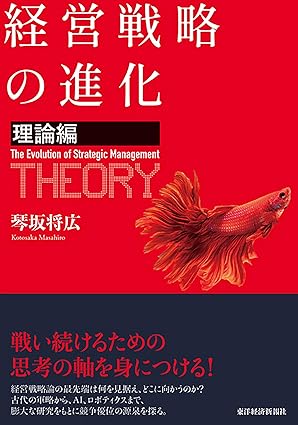
JBpress Innovation Review に、琴坂将広へのインタビュー(全2回)が掲載されました(前編:2026年7月10日、後編:2026年7月16日)。新刊『経営戦略の進化〈理論編〉』(東洋経済新報社)を起点に、2010年代半ば以降に台頭した経営戦略論の 「4つの新潮流」——実践・行動としての戦略、多層的境界の戦略、非市場・制度戦略、そしてアルゴリズムとロボティクス——を、鈴木敏文氏とセブン-イレブン、ウーバー、テスラの「オプティマス」といった事例から読み解いています。
A two-part interview with Masahiro Kotosaka has appeared in JBpress Innovation Review (Part 1: 10 July 2026; Part 2: 16 July 2026). Taking his new book The Evolution of Strategic Management (Theory) (Toyo Keizai) as its starting point, the interview reads the four new currents of strategic management that have risen since the mid-2010s — strategy as practice and behaviour, the strategy of multilayered boundaries, non-market and institutional strategy, and algorithms and robotics — through cases such as Toshifumi Suzuki and Seven-Eleven, Uber, and Tesla's "Optimus."
なぜいま、最先端の経営戦略論を学ぶのか · Why study the latest strategy now
琴坂は、経営戦略論の研究アプローチが2010年代半ば以降に大きく変わり、これまで距離があるとされてきた「実務」と「研究」が接近してきたと整理します。国際学術誌『ストラテジック・マネジメント・ジャーナル』でも、研究者向けの理論的要旨に加えて実務者向けの要約が求められるようになりました。背景には、社会の多様化やAI・ロボティクスの進展があります。過去の経験則や社内独自のやり方だけに頼るのではなく、世界の研究者・実務家が積み上げてきた「集合知」としての型を理解し、自社の戦略に取り込むことが重要だ——本書執筆の動機は、その新潮流を経営者にわかりやすく伝えることにあった、と述べています。
Kotosaka observes that the research approach to strategy shifted markedly from the mid-2010s, bringing the long-separated worlds of practice and research closer together; leading journals such as the Strategic Management Journal now ask for a practitioner summary alongside the theoretical one. Behind this lie social diversification and the advance of AI and robotics. Rather than relying on past experience or in-house convention alone, he argues, managers should understand the accumulated "collective knowledge" of researchers and practitioners and fold it into their own strategy — and conveying that shift plainly was his motivation for the book.
実践・行動としての戦略 — 鈴木敏文氏とセブン-イレブン · Strategy as practice and behaviour — Suzuki and Seven-Eleven
2026年5月に逝去したセブン&アイ・ホールディングス元会長の鈴木敏文氏を例に、琴坂は第一の潮流「実践・行動としての戦略」を説明します。出発点はダイナミック・ケイパビリティ理論(資源を環境変化に合わせて組み替える「能力」)ですが、その「中身」を、個人の認知や日々の実践というミクロのレベルまで降りて解き明かそうとするのがこの潮流です。1980年代、鈴木氏はPOSデータを単なる売上の数字ではなく消費者心理や行動変化を映す情報として読み取り(個人の認知的能力)、さらに「この事実から次に何をすべきか」を問う仮説検証の型を組織に浸透させました。個人の認知と、現場で共有・反復される組織ルーティンが結びついたことが、単品管理という競争優位の源泉になった、という読み解きです。個人の認知的能力はあくまで出発点で、経営陣・ミドル・現場の各層でバイアスを抑え、組織全体の認知的能力を高める「組織デザイン」が問われる、と続けます。
Using Toshifumi Suzuki — the former Seven & i Holdings chairman who died in May 2026 — as his example, Kotosaka explains the first current, "strategy as practice and behaviour." Its starting point is dynamic-capability theory (the capability to reconfigure resources as the environment changes), but this current opens that black box down to the level of individual cognition and everyday practice. In the 1980s, Suzuki read point-of-sale data not as mere sales figures but as a window onto consumer psychology and behaviour, and — crucially — embedded across the organisation a hypothesis-testing habit that asked "what should we do next given this fact?" It was the linking of one person's cognition with shared, repeated organisational routines that produced the single-item management behind the chain's advantage. Individual cognition is only the point of departure, he adds; the task is to design an organisation that curbs bias and raises the cognitive capability of every layer.
多層的境界の戦略 — 企業間の「関係性」を設計する · The strategy of multilayered boundaries
第二の潮流は「多層的境界の戦略」です。競争優位の源泉を外部環境への適応に見る市場ベースの視座、内部資源に見る資源ベースの視座に対し、企業間や企業と個人の「関係性」そのものに源泉を見いだすのが関係論的な視座だと琴坂は説明します。トヨタの系列や旧・松下の企業集団も関係性を競争力に変えてきましたが、歴史的・属人的な結びつきが強く、意図して設計されたものではありませんでした。これに対し、インターネット企業は表示順位やアカウント運用などのルールを自ら設定し、参加者との関係性を戦略的にデザインしてきました。鍵は「オープンかクローズか」で、共通規格で世界中の多様な相手を取り込むオープンなネットワークの重要性が増している——今後はデータ分析とアーキテクチャ設計に基づく、戦略的でオープンな企業間関係の構築が競争優位を左右する、と述べます。
The second current is the "strategy of multilayered boundaries." Against the market-based view (advantage from adapting to the external environment) and the resource-based view (advantage from internal resources), the relational view locates advantage in the relationships between firms, and between firms and individuals. Japan's keiretsu (Toyota) and enterprise groups (the former Matsushita) turned such relationships into strength, but these ties were historical and personal rather than deliberately designed. Internet companies, by contrast, set their own rules — ranking, account management — and designed their relationships with participants strategically. The key is whether a network is open or closed: open networks that draw in diverse partners worldwide through shared standards are growing in importance, and designing strategic, open inter-firm relationships on the basis of data and architecture will increasingly decide who sustains advantage.
非市場・制度戦略 — ルールそのものを巡る競争 · Non-market and institutional strategy — competing over the rules
第三の潮流は「非市場・制度戦略」です。これは、法律・制度・規範・慣習・常識といった「社会のルール」に意図的に働きかけ、自社に有利な環境をつくって競争優位につなげる戦略です。従来、競争環境は企業の外側にある所与の前提として扱われてきましたが、市場の「なかで」競うだけでなく、市場の「ルールそのもの」を巡って競うという発想への転換だと琴坂は述べます。象徴例がウーバーで、当時の法制度では認められていなかった事業を「交通の民主化」として位置づけ直し、ロビー活動や地域を巻き込んだキャンペーンを通じて世論と規制当局に働きかけました。競争環境は与えられるものではなく、自ら働きかけて変えられる——制度やルールづくりへの関与は、いまやあらゆる企業の経営課題だ、という指摘です。
The third current is "non-market and institutional strategy": deliberately acting on society's rules — law, institutions, norms, customs, common sense — to shape a favourable environment and turn it into advantage. Where the competitive environment was once treated as a given external premise, Kotosaka describes a shift toward competing not only within the market but over its very rules. The emblematic case is Uber, which recast a business that the law of the day did not permit as the "democratisation of transport," and worked on public opinion and regulators through lobbying and community campaigns. The environment is not simply handed down but can be reshaped by acting on it; engaging in rule-making, he notes, is now a management task for every company, not only regulated industries.
アルゴリズムとロボティクス — テスラの「オプティマス」 · Algorithms and robotics — Tesla's Optimus
第四の潮流は「アルゴリズムとロボティクス」です。テスラの自律型ヒューマノイド「オプティマス」を、人間・アルゴリズム・ロボティクスの新しい協働関係を示す事例として、琴坂は取り上げます。重要なのは、ロボットが人間の作業を代替するという話にとどまらず、アルゴリズムとロボティクスが「組織の一員」として機能し始める点です。経営戦略論はこれまで、戦略の策定・選択・実行・評価を人間が担う前提に立ってきました。しかし、情報処理や最適化に優れるアルゴリズム、精密性・持続性・物理的な実行力に優れるロボット、そして創造性・直感・価値判断を担う人間が、それぞれの強みを生かして循環的に協働する時代が近づいています。ロボットが「道具」から「組織メンバー」へと変わる入り口にあり、アルゴリズムとロボティクスを前提とした経営戦略論の再構築が、次世代の重要な研究課題になる、と述べます。
The fourth current is "algorithms and robotics." Kotosaka takes Tesla's autonomous humanoid "Optimus" as a case that points to a new division of labour among humans, algorithms, and robots. What matters is not merely that robots substitute for human work, but that algorithms and robotics are beginning to function as members of the organisation. Strategy has implicitly assumed that humans formulate, choose, execute, and evaluate; yet a cycle is approaching in which algorithms generate options, humans make value judgements, robots carry them out, and the results feed back into learning — each contributing its strengths. Robots are at the threshold of shifting from "tool" to "organisational member," and rebuilding strategy on the premise of algorithms and robotics, he argues, will be a central research question for the next generation.
「4つの新潮流」を経営のトップマターに · Making the four new currents a top priority
結びとして琴坂は、経営戦略論は一度学べば終わりの固定知識ではなく、社会・技術・産業構造の変化に応じて進化し続けるものだと強調します。過去にMBAなどで学んだ枠組みが、いまの環境では古びている可能性もあります。経営者や変革リーダーには、認知心理学・行動経済学の知見を踏まえて個人とチームの行動を設計すること、顧客・取引先・地域社会・行政・業界団体など多様なアクターとの関係を築くこと、ルールメイキングに意図的に関与すること、そしてAI・ロボットを単なる効率化の道具ではなく協働の相手として役割分担を設計すること——これらが求められます。渉外や顧客対応の部門任せにせず、経営者自身が向き合うべき最重要の経営課題であり、その進化を理解して自社の戦略に実装できるかどうかが、これからの競争力を左右する、と締めくくっています。
In closing, Kotosaka stresses that strategy is not a fixed body of knowledge learned once and for all but something that keeps evolving with society, technology, and industry structure; frameworks learned years ago in an MBA may already be dated. Managers and transformation leaders are asked to design the behaviour of individuals and teams with the help of cognitive psychology and behavioural economics; to build relationships with diverse actors — customers, partners, communities, government, industry bodies; to engage deliberately in rule-making; and to design the division of roles with AI and robots as collaborators rather than mere efficiency tools. This is not work to be left to public-affairs or customer-relations departments alone but a top priority for the chief executive, and whether a firm can understand this evolution and implement it in its own strategy will shape its future competitiveness.
掲載媒体・リンク · Outlet and links
全文は、下記のリンク(JBpress Innovation Review)からご覧いただけます。前編・後編ともに公開済みです。JBpress Innovation Review は株式会社日本ビジネスプレスが運営するメディアで、本インタビューの聞き手は三上佳大氏、文は井出浩之氏です。
The full text is available at the links below; both parts are now public. JBpress Innovation Review is operated by Japan Business Press; the interview was conducted by Yoshihiro Mikami, with text by Hiroyuki Ide.