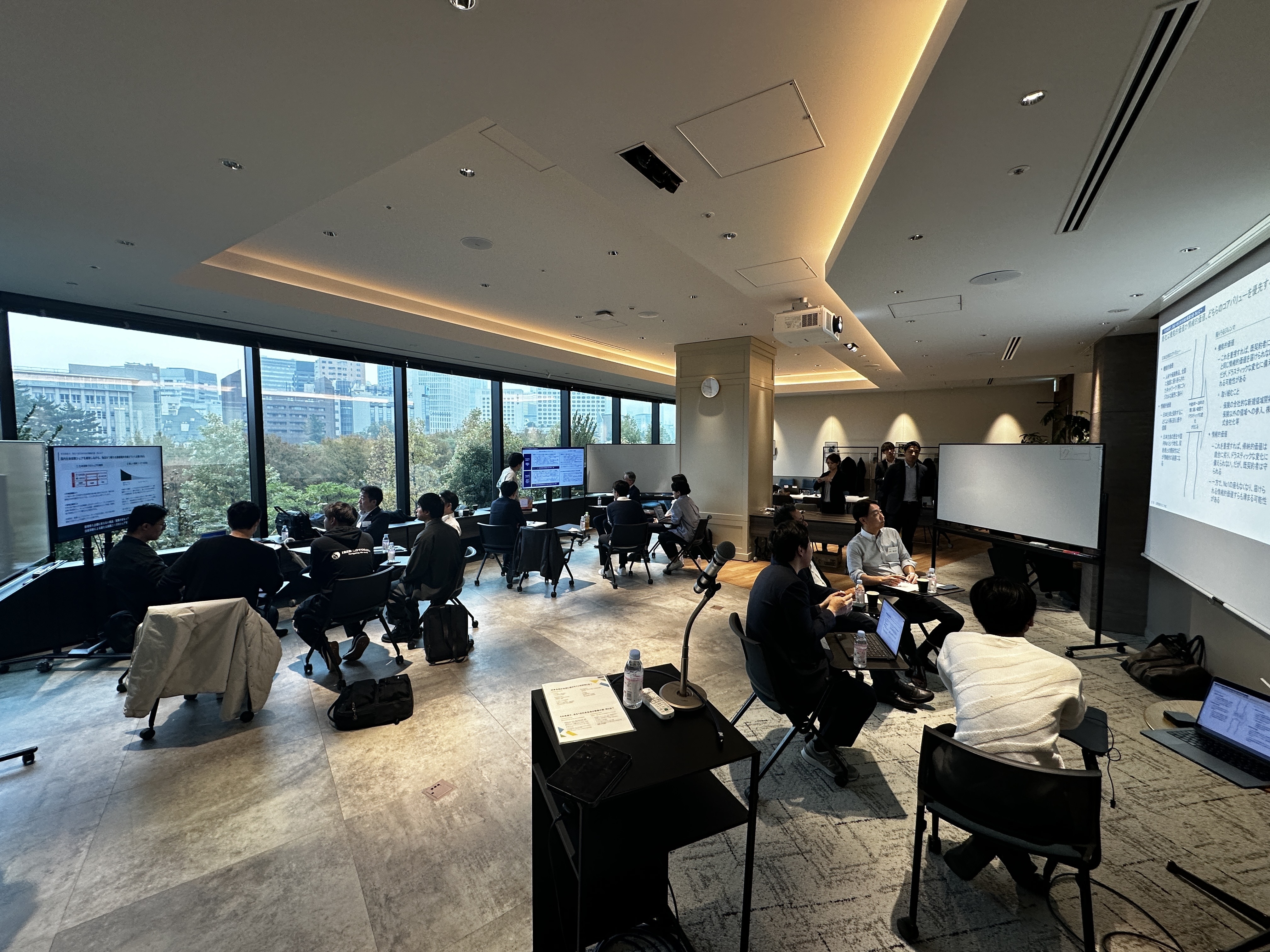
2023年11月17日(金)、琴坂研究会は、日本生命保険相互会社 との 初の合同セッション を、東京・四谷の複合施設 「コモレ四谷」 にて開催しました。テーマは 「2043年の社会環境を前提に、日本生命の事業のあり方を構想する」。学生3チームと日本生命の方々が、20年後の日本社会を出発点 に置いた状態で、これからの保険事業のあり方と、その実現に向けた経営課題を交互に発表・議論しました。具体的には、人口減少やデジタル化が進んだ未来において、日本生命がどのように 顧客接点を維持し、保険を軸に新しい安心の価値を提供していくべきか、を中心に議論を重ねました。
On Friday 17 November 2023, the IBER-Kotosaka Lab held its first joint session with Nippon Life Insurance Company, at Comoré Yotsuya in central Tokyo. The theme was "designing the future shape of Nippon Life's business, starting from the social conditions of 2043." Three student teams and a delegation from Nippon Life took turns presenting and discussing what the insurance business of the next twenty years could look like, and what managerial questions stand between today and that future. The conversation centred on how Nippon Life can keep its customer touchpoints alive in a society shaped by population decline and continuing digitalisation, and on how to deliver a new shape of "peace of mind" with insurance at its core.
合同セッションが始まった背景 · How the joint session came about
琴坂研究会は、経営戦略論・国際経営論を中心としながら、非市場戦略(規制・制度・公共政策と経営戦略の関係)にも継続して関心を払ってきました。生命保険事業は、この非市場戦略の論点が最も濃厚に立ち上がる業界の一つです。商品設計は規制と表裏一体であり、提供価値は社会保障制度の補完として位置づけられ、長期にわたる契約関係は人口動態と直接結びついています。事業そのものが、社会との接続面のうえに乗っている 産業を、研究会の学生と一緒に正面から扱える機会は、研究教育上、極めて貴重です。
The Kotosaka Lab works in strategic management and international business, with a continuing interest in non-market strategy — the interaction of regulation, institutions, and public policy with corporate strategy. Life insurance is one of the industries where these non-market questions surface most densely. Product design is inseparable from regulation; the value the industry delivers sits as a complement to the public social-security system; the long contractual horizons are directly tied to demographic trends. The chance to take an industry whose business itself is built on its interface with society head-on, with seminar students, is genuinely rare in research and teaching.
日本生命と琴坂研究会の合同セッションは、こうした問題意識を共有する関係者の間で、自然な流れの中で実現しました。初回の意義 は、何よりも「学生サイドと事業会社サイドの両方が、長期的な議論の土台として共通の言語を作っていく」点にありました。今後数年、継続して合同セッションを行っていくこと、そしてその場を通じて研究会としての知の還元と、事業会社としての構想力の補強を相互に行っていくこと。第一回はその出発点として位置づけられました。
The collaboration came together naturally among parties who shared this problem orientation. The significance of the first edition lay above all in starting to build a shared vocabulary between the student side and the firm side, as a base for a longer-running discussion. Continuing the joint session over the years ahead — and using the format both to feed seminar-side knowledge back into the business and to reinforce the firm's longer-horizon imagination — was the framing. The first session was positioned as the opening point of that arc.
「2043年」という時間軸の設定 · Why "2043" as the time horizon
合同セッションの設計上、最初に握ったのが 「20年先を出発点に置く」 という時間軸でした。生命保険のような長期商品は、目先の業績だけで構想することができません。今日新規契約された個人保険の保有期間は、容易に20年・30年に及び、その間に商品設計の前提となる社会・経済・テクノロジーの環境はほぼ確実に大きく変動します。20年後の社会から逆算して、今の事業判断を点検する 思考の型は、保険業界にとっては実務的にも理にかなった出発点でした。
One choice anchored the design of the session: placing the starting point twenty years out. A long-horizon product like life insurance cannot be conceived from short-term performance alone. New individual policies signed today routinely run twenty or thirty years, over which the social, economic, and technological environment that frames the product is almost certain to shift substantially. Working backwards from the society of twenty years from now to inspect today's business decisions is, for the insurance industry, a practically reasonable starting posture.
2043年の日本社会を考える、というテーマは抽象的にも見えますが、議論を構造化するための具体的な切り口がいくつもあります。(i) 人口動態 — 2043年の生産年齢人口、高齢化率、世帯構成、地域分布の変化、(ii) デジタル化 — 顧客接点・契約・支払い・データ活用の各領域での自動化と知能化の進展、(iii) 社会保障 — 年金・医療・介護の公私分担の更新、(iv) 個人の人生設計 — 就労・キャリア・家族・住まいの長期的な変化。これらの軸を組み合わせることで、「2043年」は単なる遠い未来ではなく、議論可能な構造を持った時点 として扱えるようになります。
"Imagining Japan in 2043" can sound abstract, but several concrete cuts give the discussion structure. (i) Demographics — the working-age population, the elderly share, household composition, and regional distribution in 2043. (ii) Digitalisation — the progress of automation and intelligence across customer touchpoints, contracts, payments, and data use. (iii) Social security — updates to the public-private split across pensions, healthcare, and long-term care. (iv) Personal life design — long-horizon shifts in work, career, family, and housing. Combining these axes lets "2043" be treated not as a distant future but as a point in time with a discussable structure.
3チームの発表と相互フィードバック · Three team presentations, with mutual feedback
当日は、研究会から組成された 3チーム がそれぞれ別の角度から「2043年の日本生命のあり方」を発表し、その後に日本生命の方々からの発表とコメントを受ける、双方向の構成で進行しました。学生からの発表は、(i) 顧客接点の長期設計、(ii) 保険を軸とした「安心」の周辺サービスとの統合、(iii) 新しい契約形態と商品設計、といった軸を中心に組み立てられました。
On the day, three teams from the seminar each presented "Nippon Life in 2043" from a different angle, after which Nippon Life's representatives presented and commented in turn — a bi-directional design. The student presentations were built around three axes: (i) long-horizon design of customer touchpoints, (ii) integration with adjacent services that surround insurance, with insurance at the centre, and (iii) new contract structures and product designs.
日本生命側からの応答は、想定として置いた未来像の甘さを丁寧に補正する種類のものでした。例えば、顧客接点 の議論では、デジタルチャネルへのシフトを単純に進めるのではなく、営業職員という対面チャネルが持つ「説明可能性の構造」 をどう次世代に翻訳するか、という論点が示されました。商品設計 の議論では、医療・介護・人的資本・地域インフラといった隣接領域との連携が単なる「サービス追加」ではなく、保険会社が担ってきた長期的な信用の蓄積を、どの領域に拡張するか という意思決定であることが指摘されました。
The responses from Nippon Life carefully corrected the optimistic edges of the students' future scenarios. In the discussion on customer touchpoints, the point landed that simply shifting toward digital channels would miss something important: the "structure of explainability" that the field-sales channel of agents has historically carried, and how that structure could be translated into the next generation. On product design, the response highlighted that integration with adjacent fields — healthcare, long-term care, human capital, regional infrastructure — is not a question of "adding services," but a strategic decision about where to extend the long-horizon trust the insurance industry has accumulated over generations.
研究会としての位置づけ · How the seminar reads this session
琴坂研究会としては、今回の第一回が、「事業会社の長期構想を、研究会の学生が早い段階から内側で議論できる場」 として機能したことを、何よりの成果として受け止めています。経営戦略論を学部の段階から研究する意味は、学術的な体系を頭に入れることだけでなく、その体系を 現実の不確実性の前で動かしてみる 経験を持つことにあります。生命保険のような、長期で公共性の高い産業は、その経験を最も濃く積める場の一つです。
For the IBER-Kotosaka Lab, the principal takeaway from this first edition was that the format had worked as "a setting where seminar students can engage with a firm's long-horizon strategic discussion from the inside, at an early stage." The reason for studying strategic management at the undergraduate level is not only to absorb a body of theory; it is to acquire the experience of putting that body of theory to work in front of real uncertainty. A long-horizon, highly public industry like life insurance is one of the densest possible settings for that experience.
同時に、初回の議論を通じて、研究会としても次回以降に取り組むべき 論点の地図 がはっきりしてきました。顧客接点・商品設計・社会保障の補完・地域インフラ・データ活用 といった複数の軸が、独立に動くのではなく、「安心」という上位概念のもとで束ねられる 構造であること。次回はこの構造を 「安心の多面体」 という言葉で改めて引き取りながら、議論をさらに具体に深めていくことになります。
At the same time, the first discussion sketched the map of the questions the seminar would want to take up in subsequent editions. Customer touchpoints, product design, the complementarity with the public social-security system, regional infrastructure, and data use do not move independently of each other; they are bound together under the higher-order concept of "peace of mind." The next edition would take this structure forward under the phrase "the multi-faceted shape of peace of mind" and push the discussion further into specifics.